
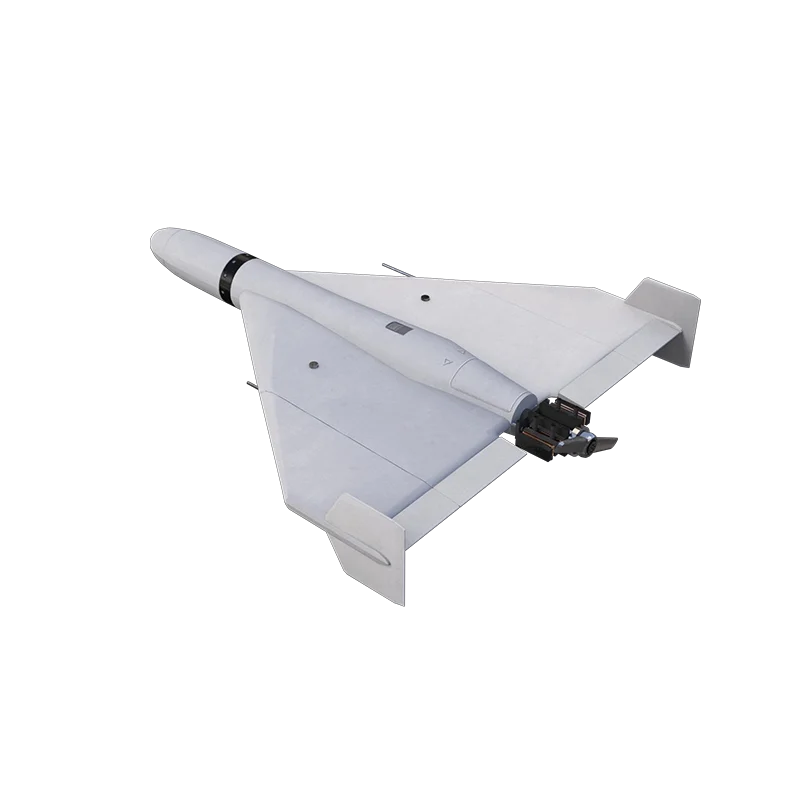
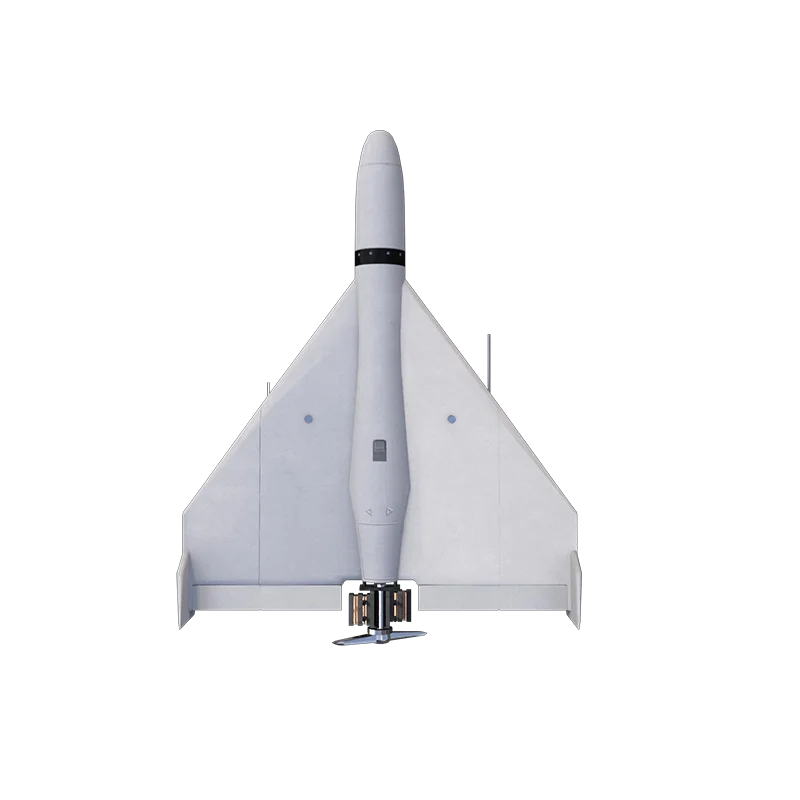
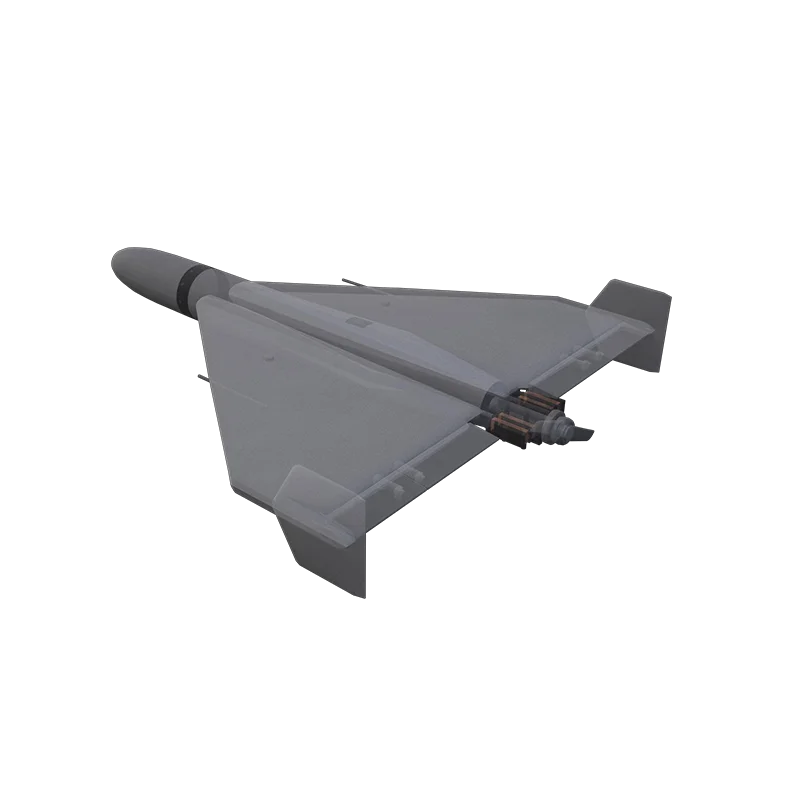
Delta-wing unmanned aerial vehicle system
Tactical and Technical Specifications
- Wingspan: 2500 mm
- Wind Resistance: Level 7
- Fuselage Length: 3300 mm
- Operating Temperature: -25℃~60℃
- Max Load: 50 kg
- Fuel Tank Capacity: 100 L
- Maximum Takeoff Weight: 183 kg
- Climb Rate: 5 m/s
- Cruise Speed: 50 m/s
- Pitch Angle: 15°
- Maximum Speed: 65 m/s
- Roll Angle: 28°
- Maximum Flight Range: 1500 km
- Terminal Guidance Attack Angle: 15°-70°
- Flight Time: 7-8 h
- Launch Method: Rocket-assisted Takeoff
- Service Ceiling: 4500 m
- Cruise Fuel Consumption: 10-12 L/h
Main Functions
Reconnaissance, Surveillance and Target Designation
Equipped with infrared thermal imagers, synthetic aperture radar and other payloads, it can perform low-altitude penetration reconnaissance day and night, accurately identify ground targets and transmit coordinates back, providing target designation for firepower strikes.
Precision Strike and Payload Delivery
Through dual payload bays or integrated mounting, it carries small guided bombs, air-to-air missiles and other weapons to perform pinpoint strike missions. Some models can deploy micro decoys and electronic jamming payloads to interfere with enemy radar or communication systems.
Electronic Warfare and Stealth Penetration
Large delta-wing UAVs adapted with stealth design can break through enemy air defense systems with low detectability, while carrying electronic reconnaissance and jamming modules to collect enemy electromagnetic signals or suppress their operational communications.
Surveying and Geographic Information Collection
Equipped with LiDAR and PPK photogrammetry equipment, it efficiently completes terrain mapping and urban 3D modeling, suitable for infrastructure exploration, land surveys and other scenarios. Data accuracy and operational efficiency are superior to traditional surveying methods.
Additional Info
High-performance delta-wing UAV system with extended range capabilities, suitable for strategic reconnaissance, electronic warfare, and precision strike operations in complex environments.